Programme Name:
UPU Code:
Short Code:
Programme Durration:
Course Composition:
111 credits
31 credits
Mechanical Engineering Technology (Maintenance Technology) encompasses a range of knowledge disciplines aimed at ensuring the reliable operation and longevity of mechanical equipment through effective inspection, diagnosis, maintenance planning, repair, and optimization strategies.
Programme Educational Objectives (PEO) is specific goals describing expected achievements of graduates in their career and professional life after graduation. Below are the PEO for Faculty of Engineering Technology.
PEO1 Graduates who are able to practice the knowledge in Mechanical Engineering Technology (Maintenance Technology).
PEO2Â Graduates who are able to engage with continuous development and adapt to evolving technologies.
PEO3 Graduates who are able to adapt professional ethics and leadership to meet the needs of the society.
Programme Outcomes (PO) are what students are expected to be able to perform or attain by the time of graduation. These relate to the skills, knowledge, and behaviour that students acquire through the programme.
Upon completion of this program, graduate should be able to:
PO1 – Engineering Knowledge
Ability to apply knowledge of mathematics, natural science, computing and engineering fundamentals and engineering specialization principles to defined and applied engineering procedures, processes, systems or methodologies in the field of Mechanical Engineering Technology (Maintenance Technology).
PO2 – Problem Analysis
Ability to identify, formulate, research literature and analyse broadly-defined engineering problems reaching substantiated conclusions using analytical tools with considerations for sustainable development appropriate to Mechanical Engineering Technology (Maintenance Technology).
PO3 – Design/Development of Solutions
Ability to design solutions for broadly-defined engineering technology problems and contribute to the design of systems, components or processes to meet identified needs with appropriate consideration for public health and safety, whole-life cost, net zero carbon as well as resource, cultural, societal, and environmental considerations.
PO4 – Investigation
Ability to conduct investigations of broadly-defined engineering problems; locate, search and select relevant data from codes, data bases and literature, design and conduct experiments to provide valid conclusions.
PO5 – Tool Usage
Ability to select and apply, and recognize limitations of appropriate techniques, resources, and modern engineering and IT tools, including prediction and modelling, to broadly-defined engineering problems.
PO6- The Engineering Technologist and the World
Ability to analyze and evaluate sustainable development impacts to: society, the economy, sustainability, health and safety, legal frameworks, and the environment, in solving broadly-defined engineering problems.
PO7 – Ethics
Ability to understand and commit to professional ethics and norms of engineering technology practice and adhere to relevant national and international laws. Demonstrate an understanding of the need for diversity and inclusion.
PO8- Individual and Collaborative Team Work
Ability to function effectively as an individual, and as a member or leader in diverse and inclusive teams and in multi-disciplinary, face-to-face, remote and distributed settings.
PO9 – Communications
Ability to communicate effectively and inclusively on broadly-defined engineering activities with the engineering community and with society at large, by being able to comprehend and write effective reports and design documentation, make effective presentations, taking into account cultural, language, and learning differences.
PO10 – Project Management and Finances
Ability to apply knowledge and understanding of engineering management principles and economic decision-making to one’s own work, as a member and leader in a team and to manage projects in multidisciplinary environments.
PO11 –Â Life Long Learning
Ability to recognize the need for, and have the ability for independent and life-long learning and critical thinking in the face of new specialist technologies.

The followings are what you will study as a student in Mechanical Engineering Technology at FTKM, UTeM.
Basic subjects to enhance the knowledge on fundamental theories in Mechanical Engineering Technology. This includes the laboratory practices to sharpen the theoretical concepts and also non-engineering subjects
Basic mathematics, non-engineering subjects and laboratories practices.
Core engineering subject, laboratory practices.
Fundamental core subjects of Mechanical Engineering Technology. Still include the laboratory practices and engineering subjects.
Advanced core subjects of Mechanical Engineering Technology. This includes a project where students work in a team to produce mechanical product applying all the fundamental theories already studied in the class.
Advance core subjects of Mechanical Engineering Technology. Still include the laboratory practices.
Elective Subjects, Final Year Projects and Internship
Selection of electives. Student will work on a supervised Final Year Project. Student will also go for industrial training in an industry for one semester.
With great minds and facilities, comes great responsibilities.
W = University Compulsory Course; P = Common Core Course; K = Programme Core Course; E = Elective
Year 1 (Semester 1 & 2)
Year 2 (Semester 3 & 4)
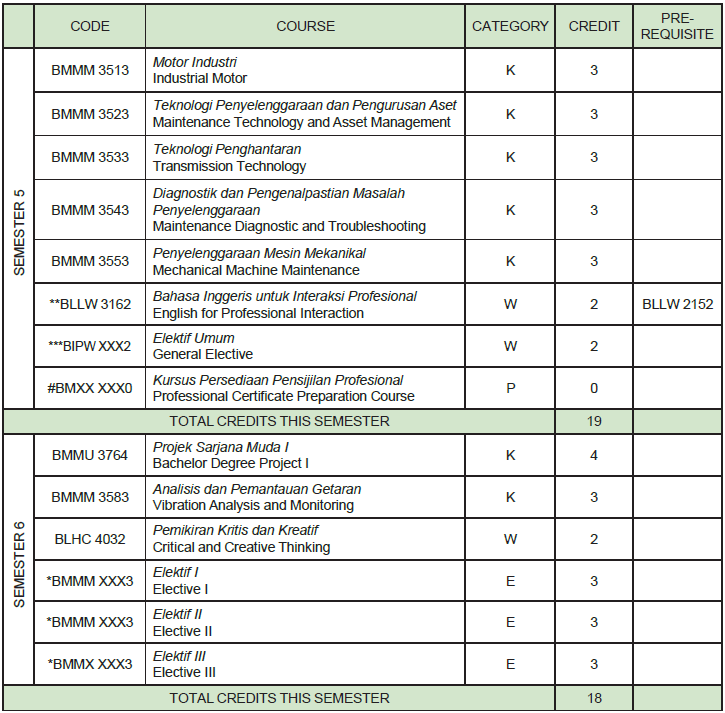
Year 3 (Semester 5 & 6)
Year 4 (Semester 7 & 8)
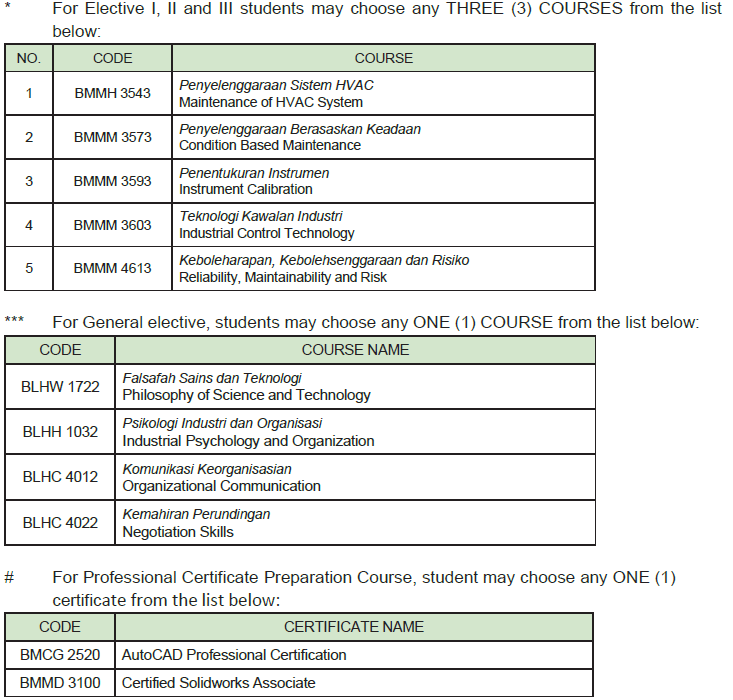
Elective Courses
W = University Compulsory Course; P = Common Core Course; K = Programme Core Course; E = Elective
| Code | Course | Cat. | Credit |
|---|---|---|---|
| BLLW 1142 | ENGLISH FOR ACADEMIC PURPOSES | W | 2 |
| BLHW 1762 | PHILOSOPHY AND CURRENT ISSUES | W | 2 |
| BMIG 1313 | ENGINEERING MATHEMATICS I | P | 3 |
| BITG 1233 | COMPUTER PROGRAMMING | P | 3 |
| BMIG 1213 | ENGINEERING MATERIALS | P | 3 |
| BELG 1123 | PRINCIPLES OF ELECTRIC AND ELECTRONICS | P | 3 |
| BMKU 1412 | MANUFACTURING PROCESS | K | 2 |
| TOTAL | 18 |
*Refer to Third Language Courses table offered by Centre for Languages and Human Development.
International students are required to take BLHL1012 Bahasa Melayu Komunikasi
**Only for Malaysian students
***Only for International students
| Code | Course | Cat. | Credit |
|---|---|---|---|
| BKKX XXX1 | CO-CURRICULUM I* | W | 1 |
| BLHL 1XX2 | LANGUAGE ELECTIVE*** | W | 2 |
| BELG 1233 | PRINCIPLES OF INSTRUMENTATION AND MEASUREMENT | P | 3 |
| BMKU 1313 | ENGINEERING GRAPHICS AND CAD | P | 3 |
| BMKU 1113 | STATICS | P | 3 |
| BMKU 1511 | MECHANICAL ENGINEERING WORKSHOP | K | 1 |
| BMKC 1013 | DIFFERENTIAL EQUATIONS | P | 3 |
| TOTAL | 16 |
*Refer to Co-Curriculum Courses offered by Centre for Languages and Human Development.
| Code | Course | Cat. | Credit |
|---|---|---|---|
| BLHW 2772 | APPRECIATION OF ETHICS AND CIVILISATIONS*/ MALAYSIAN CULTURE** | W | 2 |
| BELG 2443 | ENGINEERING MATHEMATICS II | P | 3 |
| BMKU 2222 | MICROPROCESSOR TECHNOLOGY | K | 2 |
| BMKU 2213 | DYNAMICS | K | 3 |
| BMKU 2323 | COMPUTER AIDED DESIGN & MANUFACTURING | K | 3 |
| BMKU 2713 | THERMODYNAMICS I | K | 3 |
| BMKU 2521 | MECHANICAL ENGINEERING LABORATORY I | K | 1 |
| TOTAL | 17 |
*Refer to Co-Curriculum Courses offered by Centre for Languages and Human Development
**Only for Malaysian students
***Only for International students
| Code | Course | Cat. | Credit |
|---|---|---|---|
| BLLW 2152 | ACADEMIC WRITING (pre-requisite BLLW 1142) | W | 2 |
| BKXX XXX1 | CO-CURRICULUM II* | W | 1 |
| BERN 2143 | ENGINEERING STATISTICS | P | 3 |
| BELG 2433 | ELECTRICAL SYSTEMS | P | 3 |
| BMKU 2613 | FLUID MECHANICS I | K | 3 |
| BMCG 3113 | SOLID MECHANICS II | K | 3 |
| BMKU 2723 | THERMODYNAMICS II (pre-requisite BMKU 2713 | K | 3 |
| TOTAL | 18 |
| Code | Course | Cat. | Credit |
|---|---|---|---|
| BLLW 3162 | ENGLISH FOR PROFESSIONAL INTERACTION (Pre-requisite BLLW 2152) | W | 2 |
| BMKU 3531 | MECHANICAL ENGINEERING LABORATORY II | K | 1 |
| BMIU 3213 | ENGINEERING MANAGEMENT AND ECONOMY | P | 3 |
| BMKC 3022 | SUSTAINABILITY AND ENVIRONMENT | K | 2 |
| BMKU 3623 | FLUID MECHANICS II (Pre-requisite BMKU 2613) | K | 3 |
| BMKU 3133 | SOLID MECHANICS II (Pre-requisite BMKU 2123) | K | 3 |
| BMKU 3243 | CONTROL ENGINEERING | K | 3 |
| TOTAL | 17 |
| Code | Course | Cat. | Credit |
|---|---|---|---|
| BMKU 3333 | FINITE ELEMENT ANALYSIS | K | 3 |
| BMKU 3733 | HEAT TRANSFER | K | 3 |
| BMKU 3343 | ENGINEERING DESIGN | K | 3 |
| BMKU 3253 | MECHANICAL VIBRATION | K | 3 |
| BMKU 3233 | MECHANICAL DESIGN | K | 3 |
| BXXX XXX2 | GENERAL / OPEN ELECTIVE* | W | 2 |
| TOTAL | 17 |
| Code | Course | Cat. | Credit |
|---|---|---|---|
| BMKC 3915 | INDUSTRIAL TRAINING | P | 5 |
| TOTAL | 5 |
| Code | Course | Cat. | Credit |
|---|---|---|---|
| BMKC 4972 | FINAL YEAR PROJECT I | P | 2 |
| BMKU 4743 | RENEWABLE ENERGY | K | 3 |
| BMKC 4032 | ENGINEER AND SOCIETY | P | 2 |
| BMKC 4041 | ENGINEERING SEMINAR | P | 1 |
| BMKC 4923 | INTEGRATED DESIGN PROJECT (Pre-requisite BMKU 3343) | P | 3 |
| BTMW 4012 | TECHNOLOGY ENTREPRENEURS | W | 2 |
| BMKU 4531 | MECHANICAL ENGINEERING LABORATORY III | K | 1 |
| TOTAL | 14 |
| Code | Course | Cat. | Credit |
|---|---|---|---|
| BMKC 4944 | FINAL YEAR PROJECT II (Pre-requisite BMKC 4972) | P | 4 |
| BMKU 4XX3 | ELECTIVE I# | E | 3 |
| BMKU 4XX3 | ELECTIVE II# | E | 3 |
| BMKU 4XX3 | ELECTIVE III# | E | 3 |
| TOTAL | 13 |
| Code | Course | Cat. | Credit |
|---|---|---|---|
| THERMAL AND FLUID | |||
| BMKU 4653 | TURBOMACHINERY | E | 3 |
| BMKU 4753 | REFRIGERATION AND AIR CONDITIONING SYSTEM | E | 3 |
| BMKU 4763 | POWERPLANT SYSTEM | E | 3 |
| BMKU 4633 | COMPUTATIONAL FLUID DYNAMICS | E | 3 |
| BMKU 4643 | FLUID POWER SYSTEM | E | 3 |
| STRUCTURE AND MATERIALS | |||
| BMKU 4153 | ADVANCED SOLID MECHANICS | E | 3 |
| BMKU 4143 | FRACTURE MECHANICS | E | 3 |
| BMKU 4443 | NON DESTRUCTIVE TESTING | E | 3 |
| BMKU 4423 | COMPOSITES AND ADVANCED MATERIALS | E | 3 |
| BMKU 4433 | METALLURGY | E | 3 |
| BMKU 4453 | CORROSION AND DEGRADATION OF ALLOY STEEL | E | 3 |
| DESIGN | |||
| BMKU 4363 | MECHANISM DESIGN | E | 3 |
| BMKU 4353 | 3D PRINTING TECHNOLOGY | E | 3 |
| BMKU 4393 | DESIGN QUALITY AND RELIABILITY | E | 3 |
| BMKU 4383 | DESIGN OPTIMIZATION | E | 3 |
| BMKU 4373 | ADVANCED COMPUTER AIDED DESIGN | E | 3 |
| MAINTENANCE | |||
| BMKU 4813 | CONDITION BASED MAINTENANCE | E | 3 |
| BMKU 4823 | RELIABILITY, MAINTAINABILITY AND RISKS | E | 3 |
| BMKU 4853 | VIBRATION MONITORING OF ROTATING MACHINERY | E | 3 |
| BMKU 4833 | WEAR DEBRIS AND OIL ANALYSIS | E | 3 |
| BMKU 4863 | TRIBOLOGY | E | 3 |
| BMKU 4843 | STRUCTURAL HEALTH MONITORING | E | 3 |
*Students are required to complete four (4) courses (total of 12 credits) with at least three (3) of the courses must be from the same field.
Engineering is the art of directing the great source of power in nature for the use and convenience of man.